
Instagram Reel performance analysis means separating a distribution problem (reach) from a content problem (retention, shares, saves) instead of staring at one views number and guessing. The fix always follows the diagnosis, and the diagnosis always starts with which metric drops first in the funnel.
- Reach, average watch time, shares, and saves diagnose Instagram Reel performance better than raw views in 2026.
- High reach with low average watch time points to a hook problem, not a distribution problem.
- High watch time with low shares means the content held attention but gave nobody a reason to send it.
- Trender's Reel analysis flags which metric is weak and suggests a fix based on patterns from over 1 million high-performing Reels.
- Test one variable at a time — hook, pacing, or caption — never three changes in the same Reel.
Why This Matters
Most creators and social media managers open Instagram Insights, see a views number, and either panic or celebrate without checking anything else. That number tells you almost nothing on its own — a Reel with 40,000 plays and a 20% average watch time performed worse than a Reel with 8,000 plays and a 70% average watch time, because the second one is being pushed by the algorithm precisely because people stay.
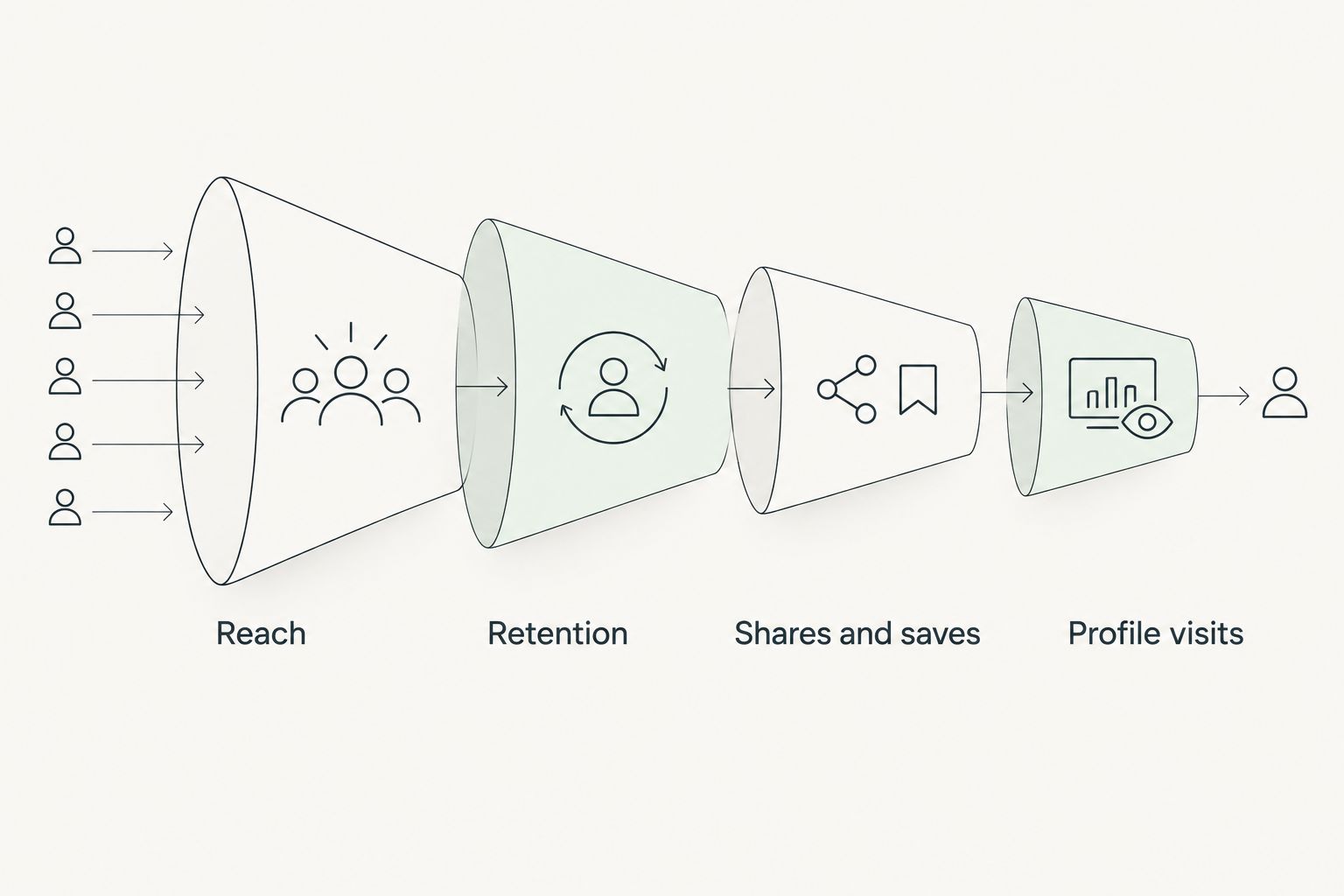
Analyzing Instagram Reel performance correctly means reading four numbers in sequence: reach, retention, engagement actions, and profile conversion. Each one answers a different question, and each one points to a different fix. Skip the sequence and you'll spend 2026 rewriting hooks when your actual problem was pacing in the middle third, or vice versa.
How to Analyze Instagram Reel Performance
Open the Reel in Instagram Insights (or Professional Dashboard) and pull these four categories in order. Each answers a specific diagnostic question before you touch anything else.
| Metric | What It Tells You | Where the Fix Lives |
|---|---|---|
| Reach / Plays | Whether the algorithm showed the Reel to enough non-followers | Hook, cover frame, posting cadence |
| Average watch time / retention curve | Whether viewers stayed past the hook | Pacing, cuts, story structure |
| Shares and saves | Whether the content gave someone a reason to act | Value density, specificity, rewatch value |
| Comments and profile visits | Whether attention converted into interest in you | Caption CTA, on-screen text, niche clarity |
Read the table top to bottom, not sideways. A Reel that fails at reach never gets a fair test of its retention, and a Reel with strong retention but weak shares has a completely different problem than one with weak reach. Diagnosing the wrong layer wastes the next Reel too.
Reach and Plays: Did the Algorithm Show It to Enough People
Low reach relative to your account's typical range is a distribution signal, not a content-quality signal — Instagram is choosing not to test the Reel further, usually because of a weak first frame, a duplicated sound already saturated in your niche, or posting outside your audience's active windows. Fix the cover frame and the first half-second before you touch the script.
Retention and Average Watch Time: Did People Stay
If reach looks normal but average watch time is short, the drop-off is happening in the hook or in the first cut after it. Pull up the retention graph specifically — most Instagram accounts show a steep cliff in the first few seconds when the hook doesn't state a clear stake, and a second, smaller cliff mid-Reel when pacing sags before the payoff.
Shares and Saves: Did People Act
A Reel that holds attention but doesn't get shared or saved usually lacks a specific, useful, or quotable moment — something worth sending to a friend or bookmarking for later. Entertainment-only Reels can rack up watch time without a single save; value-dense Reels (a tip, a list, a before/after) get saved because someone plans to come back to them.
Comments and Profile Visits: Did It Convert Attention Into Interest
Profile visits and follows-from-reach show whether the Reel made someone curious about the account behind it, not just the clip itself. A Reel with strong shares but flat profile visits is often too generic — it works as content but doesn't signal what the account is about, so nobody clicks through.
A Reel that gets shared but doesn't move profile visits is a branding gap, not a content gap — the clip works, but nothing in it tells a stranger what you post about or why to follow.
Why Reel Performance Varies
A handful of drivers explain most of the swing between your best and worst Reels on the same account:
- Hook clarity — a vague opening line versus one that states a stake or a specific outcome in the first sentence
- Cover frame and first-frame legibility — whether the still image makes someone stop scrolling before sound even loads
- Pacing against the promise — a script that takes too long to deliver on what the hook implied
- Trend and audio saturation — the same sound used heavily in your niche gets less algorithmic lift over time
- Posting cadence and timing — inconsistent posting resets some of the momentum Instagram builds around active accounts
- Caption and on-screen text — whether the CTA gives someone a reason to comment, save, or visit the profile
Running Reels through a structured analysis instead of eyeballing views is exactly the workflow the Trender Reel analysis feature is built for — it flags which of these six drivers is the likely bottleneck on a specific clip and suggests a next test, drawing on patterns from more than 1 million high-performing Reels and carousels. Over 2,137 creators use Trender to turn a research pass into ready-to-post scripts, hooks, and carousels instead of starting from a blank page every time.
Diagnose your next Reel before you post it
Start free, no credit card, and get a Reel improvement plan in minutes.
If script quality itself is the bottleneck rather than diagnosis, it's worth comparing tools that generate Reel scripts directly from a topic or a competitor's proven structure — see the comparison of AI Reels script generators for how different tools handle hooks, adaptation, and output format.
What's a Good Watch Time for a Reel?
There's no fixed universal benchmark because average watch time reads relative to Reel length and your own account's history, not against a single number every account should hit. Compare each new Reel's average watch time against your own last 10-15 Reels of similar length — a Reel sitting well below that personal baseline has a retention problem worth fixing before you post the next one.
Why Did My Reel Get Views but No Shares?
A Reel gets views but no shares when it holds attention through entertainment or curiosity alone without giving the viewer something concrete to pass along. Add a specific number, a named method, or a clear before/after moment — content people can reference later gets saved and shared far more than content that's simply watchable once.
How Many Reels Should I Analyze Before Changing Strategy?
Analyze at least 5-10 recent Reels before drawing a strategy conclusion, because a single outlier — good or bad — often reflects timing or trend luck rather than a structural pattern. Look for the same metric (reach, retention, or shares) underperforming across multiple Reels before you change your hook style, pacing, or posting schedule for 2026.
FAQ
How do you analyze Instagram Reel performance?
Read reach, average watch time, shares/saves, and profile visits in that order to find which stage of the funnel is weak, then fix only that stage. Skipping the order leads to fixing the wrong problem, like rewriting a hook when the real issue is a weak cover frame.
What metrics matter most for Instagram Reels in 2026?
Average watch time, shares, and saves matter more than plays because they show whether the content held and acted on attention, not just whether it was shown. Reach still matters, but only as the first checkpoint, not the final score.
Why did my Reel reach a lot of people but get low engagement?
High reach with low engagement usually means the hook or cover frame earned the impression but the content didn't deliver a payoff worth reacting to. Check the retention graph for a steep early drop-off before assuming the audience itself is wrong.
Is Instagram Insights enough to analyze Reel performance?
Instagram Insights gives every raw metric needed, but it doesn't diagnose which one is the bottleneck or suggest a fix. Tools like Trender's Reel analysis take those same numbers and turn them into a specific next test.
How often should I check Reel analytics?
Check performance at the 24-hour and 7-day marks, since Instagram continues testing a Reel with new audiences over the first week. Judging a Reel at 3 hours often misreads a slow-building winner as a flop.
What's a sign my Reel hook isn't working?
A steep drop in the retention graph within the first few seconds, paired with reach that looks normal for your account, signals a weak hook rather than a distribution problem. The fix is the opening line and cover frame, not the whole script.
Should I delete underperforming Reels?
No — keep underperforming Reels as diagnostic data and compare their metrics against your best Reels to find the pattern. Deleting them removes the exact evidence you need to fix the next one.
One Last Thing
The most overlooked metric in this whole process isn't watch time or shares — it's the retention graph's shape, not just its average. Two Reels can share the same 45% average watch time, but one holds flat throughout while the other spikes early and craters mid-Reel; only the second one has a fixable pacing problem, and averages alone hide that difference completely.