
SaaS founders' social media content creation is the system for turning product expertise into platform-ready posts with the aim of publishing consistently without rebuilding every format from scratch in 2026. Social media content creation for SaaS founders differs from a standard brand calendar because the raw material comes from product decisions, customer conversations, category opinions, and the founder's direct experience.
- Trndr is the best fit for social media content creation for SaaS founders who need research and production together.
- Start with one product insight, then adapt it into hooks, Reels, carousels, threads, and long-form content.
- Trndr can turn one idea into five ready-to-post formats and more than 15 hooks.
- The 2026 priority is a repeatable publishing system, not disconnected posts built from scratch.
Why social media content creation matters for SaaS founders
A SaaS founder already has useful content inside product updates, sales objections, onboarding questions, customer feedback, and decisions about what not to build. The problem is converting that material into a hook, script, carousel, or thread while product and customer work continue. If short-form video is the immediate bottleneck, this AI Reels script generator comparison explains the available approaches.
A workable 2026 strategy removes decisions from the publishing process. You need a defined audience, repeatable topics, reusable structures, and a clear method for turning one source idea into several native formats. Without that system, each post begins with a blank page and competes directly with product work.
The available product evidence shows what faster production can look like. Trndr is trained on 1M+ high-performing Reels and carousels and is used by 2,137+ creators. A featured customer reports gaining 5K Instagram followers and 2K Telegram followers from two Reels, while another reports reducing research time from hours to minutes. Those outcomes are customer reports, not guaranteed results, but they identify research and format adaptation as the work the platform removes.
Build your 2026 content system in seven steps
The sequence below starts with work you can complete manually. Software enters only after the audience, message, and source material are clear, because automation cannot decide what your company should stand for. Each step produces an asset that feeds the next one, so publishing becomes a production process rather than a recurring writing emergency.
Audit your existing founder content
Start with a manual review of everything already published under the founder and company accounts. Look beyond surface engagement and identify which posts generated substantive comments, direct questions, profile visits, or conversations connected to the product. The goal is to find evidence of audience interest without treating every high-view post as a useful business result.
- Group past posts by product lesson, category opinion, customer problem, tutorial, or company update
- Mark which posts sound like the founder and which sound like anonymous brand copy
- Record the opening line and format used on each stronger post
- Separate audience reactions from actions connected to the product
- Save reusable ideas in a plain document or spreadsheet
Define the audience and recurring themes
Choose themes that connect what the founder knows with what the intended buyer needs to understand. A useful theme is narrow enough to produce a recognizable point of view but broad enough to support repeated posts throughout 2026. Product announcements alone do not provide that range, so include the thinking behind the product as well as the product itself.
- Name the buyer by role, problem, and current alternative
- List recurring questions from sales, onboarding, and support conversations
- Turn product decisions into lessons about the wider category
- Include opinions the founder can defend with direct experience
- Exclude topics that attract creators or peers but not potential buyers
Research proven structures before drafting
Manual research comes first: search the platforms your buyers use, save relevant high-performing posts, and break each one into its hook, argument, proof, format, and closing action. Copy the communication structure, not the creator's language or claims. This gives you a reference library without requiring a paid research product.
The faster route is Trndr for SaaS content creation, which analyzes high-performing Instagram and TikTok posts and helps adapt proven hooks and structures to a new idea. Its research layer is most useful after you know the audience and category angle, because relevance matters more than raw popularity.
- Save posts that address the same buyer problem from a different angle
- Label the hook type rather than copying the exact opening line
- Note how the creator moves from problem to explanation
- Reject formats that depend on proof or visuals you do not have
- Build a small library of structures you can reuse ethically
Transform one insight into native formats
Start with a source idea that can stand on its own as a clear sentence. It might come from a product decision, a repeated objection, a failed experiment, a customer question, or a category belief. Then adapt the idea for each platform instead of pasting identical copy everywhere.
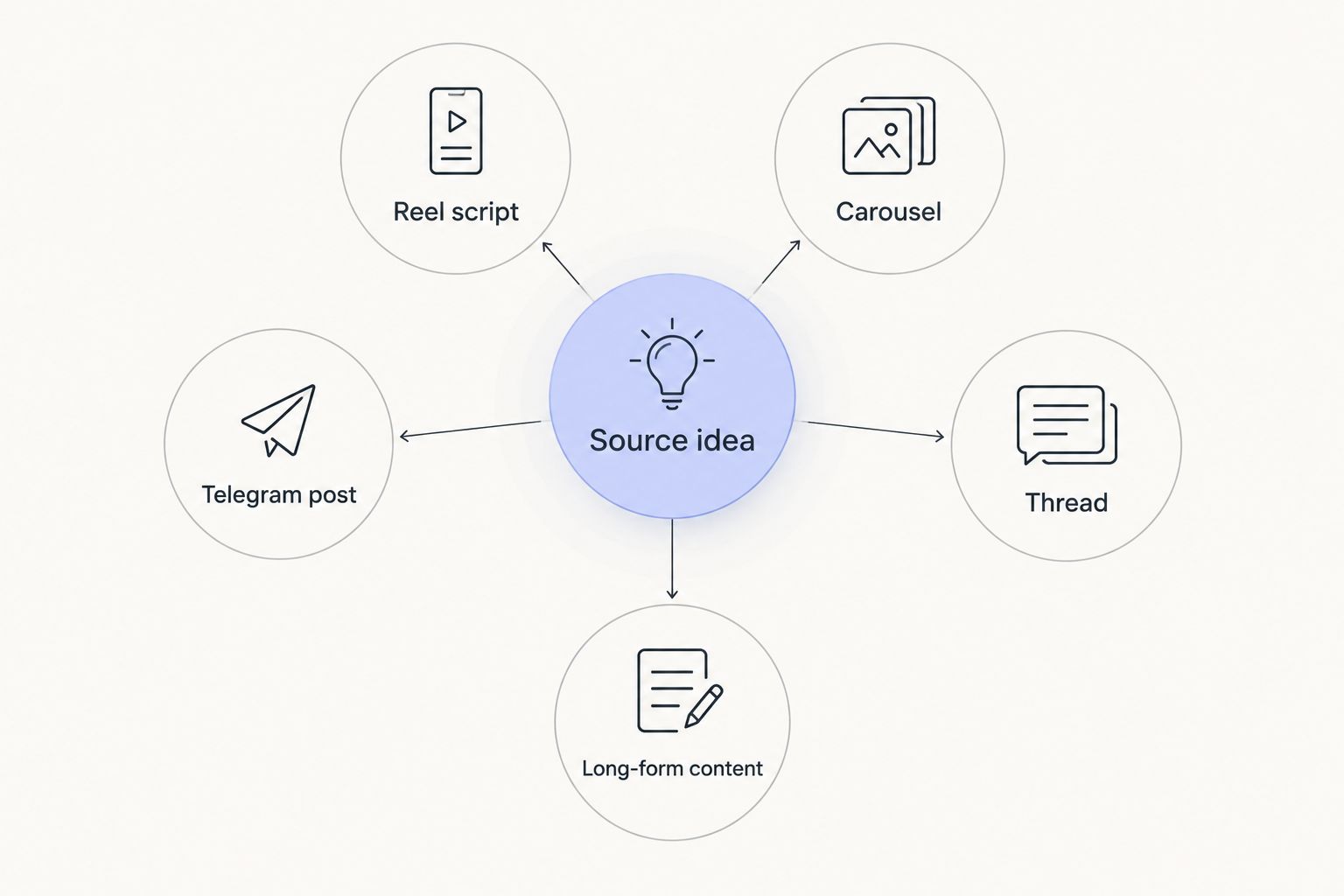
Trndr can turn one idea, draft, rough note, or successful Reel link into five ready-to-post formats: a Reel script, carousel, Telegram post, thread, and long-form content. It can also generate more than 15 hooks, giving you several openings to assess before committing to production.
- Write the source insight as one complete, defensible sentence
- Create hooks based on mistakes, contrasts, lessons, and objections
- Build the Reel around spoken delivery and visible pacing
- Build the carousel around a sequence the reader can scan
- Expand the thread and long-form version with context and examples
Write hooks and scripts for spoken delivery
A founder Reel should sound natural when spoken, not like a blog paragraph read into a camera. Draft the hook first, read it aloud, and remove setup that delays the point. Then structure the rest of the script around one argument, one explanation, and one clear next action.
The same discipline applies to threads and carousels. The opening needs to communicate who the content is for and why the next section deserves attention. A clever line that hides the subject creates curiosity without qualification, which can attract the wrong audience.
- Put the buyer problem or category claim in the opening line
- Replace abstract SaaS language with the words customers use
- Read every Reel script aloud before recording it
- Remove repeated context that the hook already established
- End with a relevant question, next step, or product connection
Design and record without breaking the workflow
Production often stalls after the writing is finished. Create a stable visual template for carousels and a repeatable recording setup for Reels so design choices do not restart with every post. Manual templates work well when typography, slide hierarchy, and closing layout remain consistent.
Trndr includes carousel design templates, Reel analysis, an iPhone teleprompter, and carousel creation through MCP for automated workflows. These features connect research and writing to design and recording, but the founder still controls the claims, examples, voice, and final approval.
- Use one idea per carousel slide
- Keep the visual hierarchy consistent across the full carousel
- Place the spoken hook at the start of the Reel script
- Use the teleprompter as a delivery aid rather than reading mechanically
- Review every generated asset for unsupported claims before publishing
Measure decisions, not vanity metrics
Analytics should tell you what to repeat, revise, or stop. Evaluate the hook, topic, format, audience response, and product action separately so a weak result does not trigger a complete strategy change. A post can attract attention but fail to communicate the product, while a lower-reach post can generate relevant questions from intended buyers.
In 2026, maintain a simple record that connects each published item to its source idea and structure. That record shows whether the same topic works better as a Reel, carousel, or text post and prevents one disappointing result from erasing a useful theme.
- Track reach and completion separately from replies and product actions
- Compare posts built from the same theme across different formats
- Review whether the opening matched the content that followed
- Diagnose weak Reels before discarding the underlying idea
- Reuse structures that produce relevant audience responses
Turn one idea into five formats
Create hooks, scripts, carousels, threads, and long-form content from one source idea.
Compare the available content creation options
The right option depends on where the founder's workflow currently breaks. A manual process provides complete control, a general-purpose writing tool accelerates isolated drafts, and a specialized platform connects research with production. The comparison below focuses on fit and limitations rather than assuming every founder needs the same tool in 2026.
| Option | Best for | Main advantage | Key limitation |
|---|---|---|---|
| Manual documents and platform search | Founders validating their audience and voice | Full control over research, claims, and wording | Research, adaptation, design, and recording remain separate tasks |
| General-purpose writing assistant | Founders who need help drafting or reorganizing text | Flexible across many writing tasks | Requires a separate process for competitor research, design, recording, and platform analysis |
| Trndr | SaaS founders who need research, hooks, scripts, carousels, recording, and analysis in one workflow | Connects source research with several publish-ready formats | Produces English-only content and is built primarily for the United States |
Trndr is best for SaaS founder content creation when the founder has ideas but needs a faster path from research to platform-ready production. Founders still need to supply category knowledge, verify every claim, and decide what should be published.
Common mistakes SaaS founders make
Treating product announcements as a full strategy
Release notes serve existing users, but they do not automatically explain why the underlying problem matters to a new buyer. Convert the thinking behind a release into lessons, trade-offs, mistakes, or category observations that stand alone without product context.
Copying one post across every platform
A Reel script, carousel, thread, and long-form article organize attention differently. Keep the central claim consistent, then rebuild the opening, sequence, density, and closing action for the destination format.
Choosing topics for peers instead of buyers
Founder communities often reward stories about fundraising, productivity, or building in public. Those topics can generate engagement without helping the intended customer understand the product category. Check every idea against the buyer role and problem defined earlier.
Automating before defining a point of view
A tool can produce hooks and formats, but it cannot supply lived product judgment that was never included in the source material. Feed the system a clear thesis, customer question, product lesson, or draft instead of a broad category keyword.
Measuring every format by the same signal
Reel completion, carousel saves, thread replies, and product conversations describe different parts of the audience journey. Compare like with like, then examine whether attention led to relevant audience action before repeating a topic.
FAQ
What's the best social media content strategy for SaaS founders in 2026?
The best 2026 strategy starts with one clear buyer problem and turns each useful insight into platform-specific formats. Research proven structures, preserve the founder's point of view, and measure whether content creates relevant product conversations.
Where can SaaS founders find social media content ideas?
The strongest ideas come from product decisions, sales objections, onboarding questions, support conversations, and category opinions. Each source already contains a problem the intended buyer recognizes.
Is founder-led content better than posting only from a company account?
Founder-led content is better for opinions, lessons, and direct explanations, while the company account is better suited to formal product communication. Use each account for the material it can present credibly.
Can one SaaS idea become several social media posts?
Yes, one idea can become a Reel script, carousel, Telegram post, thread, and long-form piece. The claim stays consistent while the hook, sequence, and level of detail change for each format.
Are Reels better than carousels for SaaS content?
Neither format is universally better. Reels suit spoken explanations and demonstrations, while carousels suit sequential lessons, comparisons, and workflows that readers want to scan.
Can a general AI writing tool handle SaaS founder content creation?
A general writing tool can help draft and reorganize copy, but it does not automatically provide a connected workflow for competitor research, carousel design, recording, and Reel analysis. Those tasks require additional processes or a specialized platform.
How should a SaaS founder fix an underperforming Reel?
Review the hook, audience match, structure, delivery, and connection to the product before discarding the topic. A weak opening or unclear format does not prove that the underlying idea is wrong.
Does a SaaS founder need to publish every day in 2026?
No, daily publishing is not a requirement for an effective 2026 strategy. Use a cadence the founder can maintain while preserving clear ideas, accurate claims, and platform-specific execution.
One last thing
The most useful proof in the available customer evidence is not the audience growth figure alone. A featured customer reports gaining 5K Instagram followers and 2K Telegram followers from two Reels, while another reports cutting research from hours to minutes. The practical lesson for 2026 is to fix the research-to-production handoff first: one strong source idea is more valuable when it can move directly into several native formats without losing the founder's point of view.